This week 122 years ago, over 100,000 workers, including children, marched against working conditions in the mills behind legendary labor organizer Mother Jones. Laborers kicked off the three-week strike in Kensington but the movement later spread across the East Coast in a push for a 55-hour work week and an end to night work for women and children.
Over a century later, labor’s fight continues. City services from sanitation to public libraries have been disrupted this month as Philly’s largest blue-collar workers union strikes for the first time in 40 years, demanding higher wages and better health benefits.
Philadelphia has a long history of fights for labor rights. Here are other significant strikes in the city’s history.
1835 General Strike
The first general strike in the United States occurred in Philadelphia. In May 1835, inspired by the Boston Carpenter’s Strike of 1835, coal heavers on the docks of the Schuylkill River went on strike for a ten-hour work day. This occurred at a time where work schedules were still abiding by an agricultural schedule of work from sunrise to sunset, resulting in longer summer hours. As the strike went on, other laborers such as cordwainers (shoemakers) and carpenters signed on, and by June, over 40 trades and 20,000 workers had joined the strike. At the end of the month, employees won a ten-hour workday and were allowed to leave work before sundown.
1910 General Strike
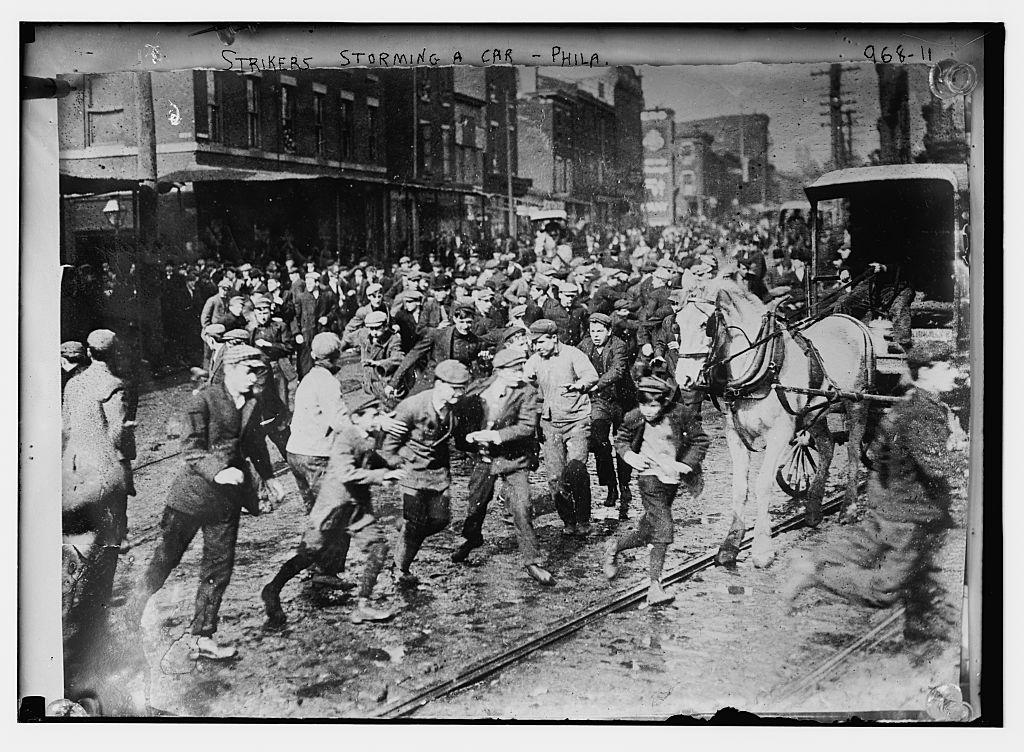
Philly’s no stranger to SEPTA’s history of strikes, and its predecessor triggered a major one in 1910. Workers of the Philadelphia Rapid Transit Company had demanded an hourly wage of 25 cents for motormen conductors; leadership refused, triggering a strike in May 1909. Violence then broke out such as strikers ignited dynamite on trolley tracks and pelted rocks at trolley cars. Both parties settled an agreement but PRT would later form its own union, ignoring the demands of the Amalgamated Association of Street and Electric Railway Transit Employes of America.
In March 1910, strikes and riots broke out once again after the transit company fired 173 workers associated with Amalgamated. The Central Federated Union called for a general strike in solidarity, with support growing to 140,000 striking workers. The streetcar workers’ strike continued until April 19, when PRT agreed to increase wages and rehire workers. The strike cost the transit company $2.3 million, according to The New York Times.
Garbage Riots of 1938
The American Federation of State, County, and Municipal Employees won its first major bargaining agreement because 2,000 sanitation workers walked off the job. The strike was triggered in September 1938 when over 260 workers for the Street Cleaning and Highways Bureau were fired for not changing their political party affiliation following the mayoral election. In one incident from the strike, over 100 people threw bottles and bricks at temporary workers in Germantown and covered Wayne Avenue with ashes and garbage. The strike ended days after AFSCME Local 222 was recognized as the union representatives for the workers, and fired employees were rehired.