
City Cast Philly logo

Pride’s Predecessor in Philly: Reminder Days

Posted on June 18, 2024   |   Updated on September 30, 2025
Asha Prihar

Asha Prihar

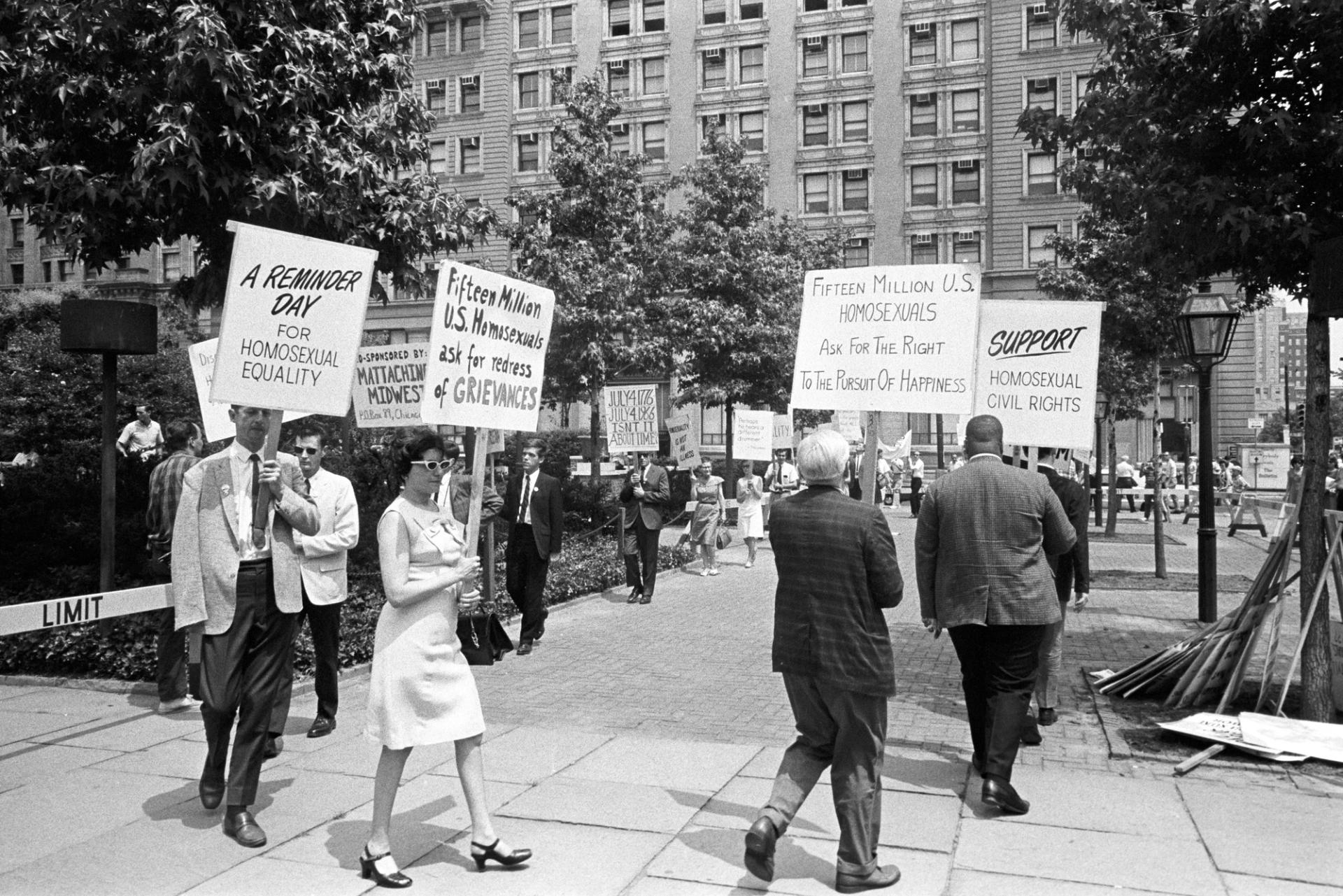
A black and white photo of picketers holding signs calling for "homosexual civil rights."

Protestors picketing for gay equality in Old City during the second Annual Reminder Day in 1966. (Bob Parent/Getty Images)

The first Philly Pride happened in 1972. By that point, however, gay and lesbian demonstrators had already been making history in Philadelphia for several years (albeit using a different approach).

For a five-year period during the 1960s, Annual Reminder Day protests were held in front of Independence Hall every July 4 following Philly’s Independence Day parade. They were organized by the East Coast Homophile Organizations, a coalition of groups from cities including New York, Philly, and Washington, D.C. Frank Kameny and Barbara Gittings (a Philadelphian) rallied people to come to the first demonstration in 1965.

The idea of the picket was to “remind” the public that lesbian and gay people in the United States weren’t afforded the same civil rights protections as other Americans.

The vibe was a lot different from Pride celebrations as we know them today. Organizers placed a strong emphasis on making sure participants were dressed in formal, business-like clothing, and picketers had to protest in a single-file line.

The focus was meant to be on presenting participants as “employable” and drawing attention primarily to the messages on their signs, said organizer Kameny, who’d previously been fired from his job because of his sexual orientation. According to the Encyclopedia of Greater Philadelphia, the dress code led some people to question whether the marches were really meant for everyone in the gay community, particularly transgender people.

The Annual Reminder Day demonstrations were small compared to today’s Pride events — each drew only a few dozen attendees, per the Historical Society of Pennsylvania. The largest one took place in 1969, the day after the Stonewall Uprising ended. A turning point in the LGBTQ+ movement and how it was perceived, the Stonewall Uprising was a series of protests and violent confrontations sparked by a police raid on a gay bar in New York City.

Around 150 people showed up for the 1969 Annual Reminder Day. During the protest, some demonstrators defied the stringent rules, notably when they started breaking from the single-file line and holding hands with their partners.

That year’s protest ended up being the final Reminder Day — in November 1969, the event’s organizers decided to shift their focus to planning the 1970 Christopher Street Liberation Day March in New York City, a commemoration of the first anniversary of the Stonewall Uprising.

Unlike the Reminder Day demonstrations, the Christopher Street event lacked a dress code and other strict rules. It became known as the first Pride parade, and LGBTQ+ people across the U.S. started following suit and holding their own marches in subsequent years.

Share article

Hey Philly

Stay connected to City Cast Philly and get ready to join the local conversation.

Can't subscribe? Turn off your ad blocker and try again.

Philly History

See All
Philly HistoryMarch 17

How St. Patrick’s Day Started in Philly

Philadelphia’s annual parade celebrating Irish culture just happened on Sunday, a tradition dating back over 200 years.

Boathouse row lit with green lights along the Schuylkill River at night
Philly HistoryMarch 9

Where To Celebrate Women’s History Month in Philly

Honor the women whose contributions impacted not just Philly, but the nation, on these tours throughout March.

A mural of abolitionist and suffragist Frances E.W. Harper and other figures on the side of Greene Street Friends School in Germantown. (Siani Colón / City Cast Philly)
Philly HistoryMarch 2

Why We Celebrate Women’s History in March

International events, such as International Women's Day, may be why we celebrate women's history in March in Philadelphia.

Shirley Chisholm, the first Black woman to run for U.S. President, photographed in 1968. (Bettmann / Getty Images)
Philly HistoryFebruary 23

To Learn About the Founding of the U.S., Go to Philadelphia’s Germantown

This Northwest Philadelphia neighborhood may not have been part of the city during the American Revolution, but it left a major impact on...

A group attends a walking tour in Germantown
Philly HistoryFebruary 18

Remember When Philly Burned Trash in Its Own Neighborhoods?

Philly has been making our trash someone else’s problem for decades.

An incineration plant. (Benoit Roy / Unsplash)
Philly HistoryJanuary 26

Where To Learn About Philly’s History of Slavery and Abolition

As the city fights to restore the slavery memorial in our historic district, here are other local sites and tours working to preserve his...

Panels detailing life under slavery in the U.S.
Philly HistoryDecember 22, 2025

This Week 252 Years Ago, Philadelphia Had Its Own ‘Tea Party’

While you might spend your Christmas Day warming up with tea, Philadelphians in 1773 were planning to get rid of it.

Painting depicting the Boston Tea Party in 1773.
Philly HistoryDecember 16, 2025

The Philadelphians Who Shaped America’s Music Scene

A new book that collects the history of hundreds of songwriters, singers, instrumentalists, and producers is a portrait of Philadelphia’s...

Microphone stand